
The problem is rarely "we have no system"
It is that the system stops where the real work starts. Data gets captured on paper at the point it actually happens — on the weighbridge, in the warehouse, at the counter — and only becomes data later, when someone types it in. Everything between those two moments is where errors, disputes and wasted hours live.
So the question we start with is not "which modules do you need". It is: where does the same figure get written down more than once?
How we work
We start at the point of capture
Not from an org chart, and not from a module list. If the data is created standing next to a truck, the interface has to work standing next to a truck — on a tablet, with gloves on, in daylight.
One entry, many uses
Once a figure exists as data, settlement, history and analysis are all just different questions asked of the same record. That is the whole economic argument for a system: not that it is modern, but that the re-typing stops.
Built to fit, not configured to fit
Off-the-shelf ERP asks you to change how you work so the software makes sense. For a mid-sized operation with one unusual process at its core, that trade is usually a bad one. We build around the process that makes your business yours.
A worked example: Chang-Fu Rice Drying Center
Chang-Fu Rice Drying Center takes in harvested grain, dries it, and settles payment with each farmer based on what comes off the weighbridge. Every one of those numbers — the truck, the load, the weight in and out — was written down on paper.
Paper is not a problem on its own. It becomes a problem when the same figure has to be copied again to settle payment, checked again when someone disputes it, and typed in a third time if anyone wants to know how prices moved across the season.
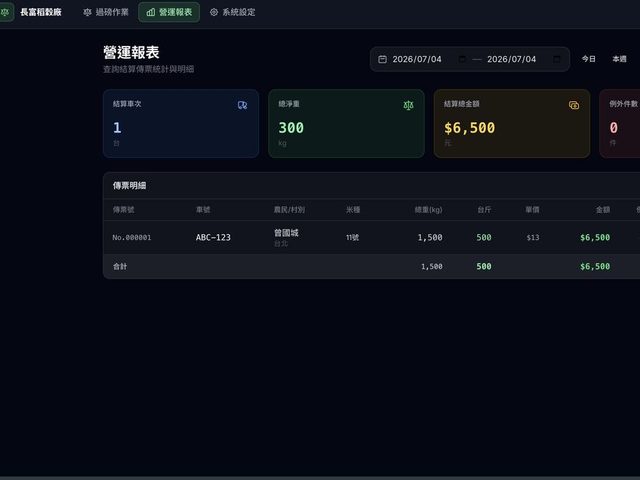
We built a weighing settlement system entered on a tablet at the weighbridge itself. Because the figure is captured as data from the start, settlement reads the same record — and price analysis stopped being a separate re-typing exercise and became something the system can answer.
Before
01Weighing recorded by hand on a paper form
02Figures copied again for settlement
03Disputes resolved by finding the original slip
04Price analysis means typing it all in again
After
01Weighing entered on a tablet where it happens
02Settlement reads the same record
03History is searchable, no paper hunt
04Price analysis is a query, not re-entry
We have deliberately not put percentages on this. Chang-Fu did not run a stopwatch on the paper process beforehand, so any number we printed here would be invented. The honest claim is the structural one: the same figure is now entered once instead of three times.
We also built this client's public website — that side of the project is described on the website development page.
What an engagement usually covers
- Walking your actual process on site, before any spec is written
- On-site data entry built for the device and conditions it will be used in
- Settlement, inventory, order or accounting flows built on that same record
- Integration with the spreadsheets or systems you already depend on
- Handover, training, and support after go-live — not a drop-and-run
Who this is a good fit for
If your operation has a core process that no off-the-shelf product quite covers, and the cost of that gap is currently being paid in re-typing, disputes and evenings — that is the gap we build for. Our full-stack engineers each double as the project contact, so you are not relaying requirements through an account manager who then relays them to a developer.
If what you need is a standard accounting package, we will say so. That is a cheaper answer than anything we would build.